
Below is a list of frequently asked questions about Advancing Alhambra. Please get in touch with us if you have any additional questions or comments.
In 2017, the Metro Board voted to discontinue the SR-710 North Study, including the tunnel alternative, and redirected funding toward local mobility improvement projects intended to address transportation needs in communities along the SR-710 corridor. Advancing Alhambra was developed as the City's effort to identify potential transportation improvements following that decision.
Advancing Alhambra is the City's effort to evaluate potential transportation improvements following the discontinuation of the SR-710 Tunnel Project. As part of this effort, the City is conducting planning studies for the 710 Mobility Improvement Projects to better understand traffic congestion, cut-through traffic, safety, and mobility needs within Alhambra while considering potential effects on neighboring communities and the regional transportation system.
The City is also developing a Bicycle and Pedestrian Improvement Plan to identify potential improvements for active transportation users. The City is seeking input from residents and other local stakeholders about their personal experiences with the four locations identified for potential improvements, as well as their needs and preferences for bicycle and pedestrian improvements. Please take a moment to share your experience today.Through technical studies, public engagement, and coordination with partner agencies, the City is evaluating potential transportation strategies and improvements. No preferred alternative has been selected.
Advancing Alhambra is currently in the planning phase. The City has completed initial planning studies and public outreach to better understand transportation challenges and identify locations for further evaluation. Four locations (the 710 Stub, Fremont Avenue, Atlantic Boulevard, and Garfield Avenue) were identified for further evaluation as part of the 710 Mobility Improvement Projects. The 710 Stub is the portion of the 710 Freeway north of Interstate 10 that currently ends at Valley Boulevard.
The City is continuing to evaluate these locations through additional technical studies, public engagement, and coordination with Caltrans and regional partners. Any potential improvements would require further environmental review and public input before a preferred alternative could be selected.
In addition, the City adopted a Bicycle and Pedestrian Improvement Plan in March 2024 to identify opportunities to improve active transportation throughout Alhambra. The Plan established a network of bicycle and pedestrian improvements and is currently being implemented using Measure R funding, with eight pedestrian locations prioritized for improvement. The City has also secured Metro Active Transportation Program funding to begin planning work associated with the City's Backbone Bike Network.
Current planning studies are evaluating potential improvements at four locations: the 710 Stub, Fremont Avenue, Atlantic Boulevard, and Garfield Avenue. Concepts under evaluation include conversion of the 710 Stub from a six-lane freeway to a four-lane arterial street between the I-10/710 interchange and Valley Boulevard, as well as potential improvements at the I-10/Fremont Ave, I-10/Atlantic Blvd, and I-10/Garfield Ave interchanges. No-build alternatives are also being considered at each location.
Advancing Alhambra is currently in the planning phase. Planning and preferred alternative selection are separate stages of project development. While concepts are developed and evaluated during planning, any potential alternative would require additional technical analysis, environmental review, public input, cost analysis, and agency approvals before a preferred alternative could be selected. Evaluation of these concepts and alternatives does not commit the City to implementing any specific improvement.
Yes. As part of the planning process, the City is evaluating opportunities to incorporate bicycle and pedestrian improvements within the four study locations, where feasible. These improvements are being considered alongside roadway improvements to support safety, mobility, and connectivity for all users.
The 710 Mobility Improvement Projects are also being coordinated with the City's Active Transportation Plan. Planning studies are evaluating how potential improvements at the four study locations could enhance connections to the City's broader bicycle and pedestrian network while balancing existing transportation needs.
One objective of the planning effort is to better understand opportunities to address congestion and cut-through traffic within Alhambra. Reducing cut-through traffic and improving overall traffic conditions can help create opportunities for safer and more connected bicycle and pedestrian facilities throughout the community.
The 710 Stub, Fremont Avenue, Atlantic Boulevard, and Garfield Avenue function as part of a connected transportation network. Potential improvements at the 710 Stub are intended to address local congestion and cut-through traffic concerns within Alhambra.
Because changes at one location can affect traffic conditions at the others, additional technical studies are being conducted to better understand those relationships. These studies will help determine whether mitigation measures may be needed elsewhere in the corridor while considering effects on neighboring communities and the regional transportation system.
The 710 Stub, Fremont Avenue, Atlantic Boulevard, and Garfield Avenue function as part of a connected transportation network. Initial planning studies identified these locations for further evaluation because traffic conditions at one location can affect travel patterns and congestion at the others. Understanding these relationships is important when evaluating potential improvements at the 710 Stub and throughout the surrounding transportation network.
Additional technical studies will help determine whether improvements at one or more of these locations may be needed to address local mobility needs while considering effects on neighboring communities and the regional transportation system.
Metro oversees the Measure R funding allocated to the City’s projects, while Caltrans owns the 710 Stub, the I-10 interchanges, and other state transportation facilities that may be affected by potential improvements.
Because these facilities are part of the state highway system, any potential improvements would require coordination with Caltrans and must follow Caltrans' project development process. As part of that process, projects are evaluated for their effects on local communities, neighboring jurisdictions, and the regional transportation system.
The City, Metro, and Caltrans each play important roles in evaluating potential improvements, and continued coordination among all three agencies will be necessary as projects move forward.
Transportation projects on the state highway system are developed through a multi-step process established by Caltrans. The process is intended to evaluate alternatives, gather public input, identify environmental impacts, refine project concepts, and obtain agency approvals before construction can occur.
Planning (Project Study Report–Project Development Support or PSR-PDS) is the initial planning phase where transportation needs are identified, conceptual alternatives are developed, and a project scope is established for future study.
Project Approval and Environmental Document (PA&ED) is the phase where detailed traffic, operational, engineering, environmental, and community impact analyses are performed. Multiple alternatives may be evaluated and refined, public input is gathered, and environmental documentation is prepared before a preferred alternative is selected.
Plans, Specifications and Estimates / Right-of-Way (PS&E/RW) includes detailed design, property acquisition if needed, permitting, and preparation of construction documents.
Construction occurs after funding is secured and all approvals are obtained.
Because the 710 Stub, Fremont Avenue, Atlantic Boulevard, and Garfield Avenue function as part of a connected transportation network, the City and Caltrans agreed on a phased project development strategy.
A key consideration was that modifications to the 710 Stub could affect traffic operations throughout the I-10 corridor. Caltrans and the City determined that a corridor-wide traffic and operational analysis would be needed to better understand existing and future traffic conditions, evaluate the effects of a potential 710 Stub arterial concept, and identify potential mitigation measures throughout the corridor.
Under Caltrans' project development process, this level of corridor-wide traffic and operational analysis occurs during the Project Approval and Environmental Document (PA&ED) phase. Improvements at the I-10/Fremont Avenue interchange contain the greatest complexity and the largest range of developed alternatives, making Fremont Avenue the most suitable location to perform this analysis and support corridor-wide decision making.
As a result, the City and Caltrans agreed to first complete planning studies for the Fremont Avenue Interchange Project and then advance Fremont Avenue PA&ED concurrently with planning studies for the SR-710 Stub. The intent was to use the corridor-wide traffic and operational analyses developed during Fremont PA&ED to evaluate how potential 710 Stub concepts and multiple Fremont Avenue alternatives perform together, identify potential traffic impacts, evaluate mitigation measures, and inform future project sequencing and decision-making throughout the corridor.
Project development phasing does not determine future construction phasing. Decisions regarding implementation would occur later in the project development process and would be informed by technical studies, environmental review, public input, funding availability, and agency approvals.
No. The City is currently in the planning phase of the 710 Mobility Improvement Projects. Additional technical studies, environmental review, public engagement, cost analysis, and coordination with Caltrans and regional partners will be conducted before any preferred alternative could be selected. The evaluation of concepts and alternatives does not commit the City to implementing any specific improvement.
No residential property acquisitions are anticipated as part of the 710 Mobility Improvement Projects. Both the City and Caltrans have directed the project team to avoid residential acquisitions and focus on alternatives that remain within existing right-of-way where feasible.
The projects are currently in the planning phase and no preferred alternative has been selected. Planning-level concepts are used to evaluate a range of potential improvements and identify issues that may require further study. Property impacts, right-of-way needs, environmental considerations, costs, and community input will all be evaluated in greater detail before any preferred alternative could be selected.
Planning-level exhibits are developed to evaluate a range of potential concepts and identify opportunities, constraints, and issues that may require further study. These exhibits are not final designs and do not determine future property acquisitions or right-of-way needs. As concepts are refined through technical studies, environmental review, and public input, project limits and potential impacts may change significantly.
Potentially, yes. The current planning studies are focused on understanding transportation needs, including congestion, cut-through traffic, safety, mobility, and connections to the surrounding transportation network. Establishing how the corridor functions from a transportation perspective is an important first step before evaluating additional opportunities.
As concepts continue to be refined, the City may evaluate how potential improvements could support broader community goals, such as enhanced bicycle and pedestrian connections, first- and last-mile access, streetscape improvements, public spaces, economic development opportunities, and other community-serving uses.
No decisions have been made regarding future land uses or community amenities within the corridor. The purpose of the current planning effort is to develop the technical information needed to better understand transportation conditions and identify feasible improvement concepts. Future planning and public engagement efforts may help inform additional opportunities as project development continues.
Yes. The 710 Mobility Improvement Projects are evaluating transportation improvements that could affect both local and regional travel patterns. As a result, coordination with neighboring jurisdictions and regional agencies is an important part of the planning process.
The City and its consultants have met and will continue to meet with neighboring cities, the San Gabriel Valley Council of Governments (SGVCOG), the City and County of Los Angeles, Metro, Caltrans, and other stakeholders as studies progress.
Potential improvements will be evaluated not only for their ability to address local mobility needs within Alhambra, but also for their effects on neighboring communities and the regional transportation system.
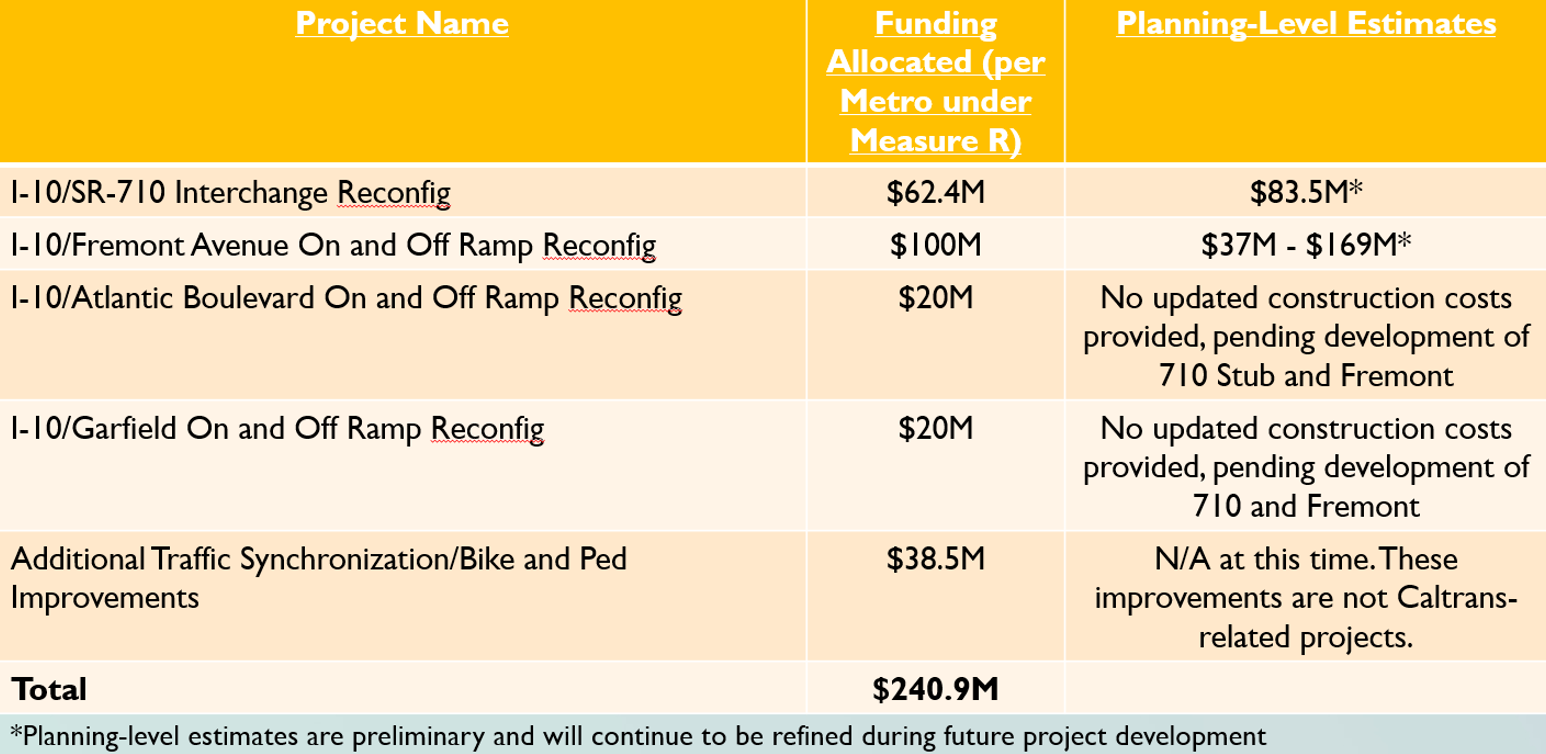
Metro's Measure R Expenditure Plan identified approximately $240.9 million for transportation improvements in the Alhambra area. These funding allocations helped establish the locations studied under the 710 Mobility Improvement Projects.
The cost estimates shown below are planning-level estimates developed from conceptual alternatives and should not be interpreted as construction bids or final project costs. Estimates include construction, support costs, and escalation to the anticipated year of construction. Where cost ranges are shown, they represent different conceptual alternatives evaluated during planning rather than a single project's uncertainty range. Because the projects are in the planning phase and no preferred alternative has been selected, costs will continue to be refined as studies and alternatives progress.
The 710 Mobility Improvement Projects involve state-owned transportation facilities and must follow Caltrans' project development process. This process includes planning studies, technical analyses, public engagement, environmental review, and coordination among multiple agencies before a preferred alternative can be selected.
Because the projects are intended to address local transportation needs while considering effects on neighboring communities and the regional transportation system, the City, Metro, Caltrans, neighboring jurisdictions, and other stakeholders all play important roles throughout project development.
In 2020, the City and Caltrans agreed to advance the four study locations in phases because the 710 Stub, Fremont Avenue, Atlantic Boulevard, and Garfield Avenue function as part of a connected transportation network. A key objective was to complete the studies needed to better understand corridor-wide traffic conditions, evaluate potential impacts associated with a 710 Stub arterial concept, and identify potential mitigation measures throughout the corridor.
In 2022, the City initiated a Planning Study (Project Study Report–Project Development Support, or PSR-PDS) for the Fremont Avenue Interchange Project in coordination with Caltrans. The purpose of the study was to identify and evaluate conceptual alternatives, establish a project scope, and determine whether the project should advance for further study. Because the Fremont Avenue Interchange contains the greatest complexity and the largest range of developed alternatives, it was identified as the most suitable location to support future corridor-wide traffic and operational analyses during the Project Approval and Environmental Document (PA&ED) phase.
During the Fremont PSR-PDS review process, the City and Caltrans worked collaboratively to refine project alternatives based on technical review, public feedback, and updated project objectives. This included evaluating opportunities to enhance safety and complete streets features while reducing potential right-of-way impacts where feasible. These refinements resulted in additional rounds of revisions before the PSR-PDS ultimately received approval.
Caltrans approved the Fremont Avenue PSR-PDS in February 2026 and authorized advancement to the PA&ED phase. PA&ED is the stage where more detailed traffic, operational, engineering, environmental, and community impact analyses are conducted. At the same time, the City and Caltrans initiated development of the 710 Stub PSR-PDS to begin evaluating potential improvements at the 710 Stub location.
Following the May 26, 2026 Alhambra 710 Town Hall Meeting, the City Council directed additional traffic and impact analyses to further evaluate the potential effects and mitigation needs associated with the 710 Stub concept before determining future project development sequencing. That work is expected to occur between Summer 2026 and year end 2026.
The following timeline summarizes major coordination milestones between the City and Caltrans associated with development of the Fremont Avenue planning study.
The community’s participation is critical to making improvements of this size and complexity happen, and we encourage public involvement throughout the process. Alhambra continues to seek input from residents and other local stakeholders about their personal experiences, needs, or concerns with the four locations identified for potential improvements. Mobility enhancement ideas subject to other considerations are also welcomed.
For more information regarding the City’s updates and early study work, please visit https://advancingalhambra.org/resources
We want to hear from you.
Share your experience with these locations here.